Who Should Pay the Deposit? Handling Big Upfront Bookings
Flights and accommodation are usually booked months early, by one person, on one card, for an amount that dwarfs everything else on the trip. It is the single largest source of group-money problems, and almost nobody plans for it.
What the booker is actually taking on
“I’ll book it and you can pay me back” sounds like a favour about logistics. It is really four separate risks landing on one person:
- Cash flow. Six months of a large balance on a card, possibly interest-bearing, possibly crowding out their own spending.
- Collection. Chasing four adults for money is a social cost they did not agree to. It is also the thing that most often turns into resentment.
- Cancellation. If someone drops out, whose money is stuck? If the whole trip dies, who eats the non-refundable portion?
- Currency. On a foreign booking, the rate is fixed the day they paid. If the group reimburses six months later at a different rate, someone gains and someone loses.
None of these are hypothetical, and all of them are cheap to solve in advance and expensive to solve afterwards.
Rule one: reimburse immediately, not at the end
The single highest-value habit in group travel. When someone books a NT$60,000 flight for four people, the other three transfer their NT$15,000 within a couple of days, not after the trip, not when the final spreadsheet is ready.
Large upfront bookings should never be inside the running trip tally. Settle them separately and early, then let the day-to-day expenses be their own exercise. It keeps the eventual settlement small enough that nobody is stressed by it.
Why this matters more than it sounds: if the big items are already square, a mistake in the trip tally is worth a few hundred dollars, not a few thousand. Errors stop being frightening, and people stop double-checking each other.
Rule two: spread the bookings across people
If there are four bookings and four people, take one each rather than making one person the group’s bank. Everyone carries a similar balance, everyone feels the same urgency about being paid back, and no single person is exposed if the trip collapses.
When it genuinely has to be one person (one card has the right travel insurance, or one person has the loyalty account), the group should acknowledge that as a favour and reimburse fastest of all.
Rule three: decide the cancellation rule before you book
Ten seconds in the group chat, months before it matters. There are only three reasonable answers, and any of them works as long as it was agreed:
- Personal risk. If you drop out, you lose your share. The default, and the fairest for the people still going.
- Shared risk. The group absorbs a cancellation together. Generous, appropriate for close friends and family, and worth saying out loud so nobody assumes it.
- Replacement rule. If you drop out, you find someone to take your place, or you cover it. Practical for houses and villas where the cost does not shrink when a person leaves.
Note the asymmetry that makes this urgent: on a rented house, one person leaving does not reduce the bill at all. Everyone else’s share goes up. Nobody expects that until it happens.
Rule four: fix the exchange rate at the moment of booking
If the booking was in a foreign currency, fix the rate on the day it was paid rather than the day people reimburse. Reimbursing at a later rate means the group is unintentionally speculating on currency, with the booker taking the whole position, and on a deposit paid six months out, that position is large and lasts a long time.
This is a deliberate exception to the convention we recommend everywhere else. For ordinary trip spending the answer is the mid-market rate applied uniformly, with card fees staying on the card that charged them; see which exchange rate to use when splitting a trip. A single large upfront booking is the case where pinning the rate to the booking date is worth the inconsistency, because the exposure is concentrated on one person for months rather than spread across everyone for a week.
Handling partial refunds without a headache
A hotel refunds one night. An airline gives back the taxes on a cancelled seat. The instinct is to reopen the whole calculation, which is how a settled group becomes an unsettled one.
Treat the refund as its own event. Whoever received it distributes it in the same proportion the original was split, and it is done, no recalculation of anything else. In the calculator, negative refund entries are not supported. Arrange separate transfers using the original shares, and retain the refund record alongside the original settlement.
Refunds below a threshold the group agrees on (the price of a coffee each) are not worth moving. Say so once and let the booker keep them.
The four-line message that prevents all of this
Send it when the trip is first proposed, before anyone books anything:
“Flights: I’ll book, everyone sends their share within a week. House: Ana books, same deal. Big bookings settle at the rate on the booking date. If someone drops out after we’ve booked, that person covers their own share.”
Nobody has ever objected to this message. Its entire value is that it exists before there is money at stake, when agreeing costs nothing.
Related reading
- How to split concert and sports event tickets : the same problem, compressed into a sixty-second ticket queue.
- Best ways to split expenses when traveling with friends
Worked example
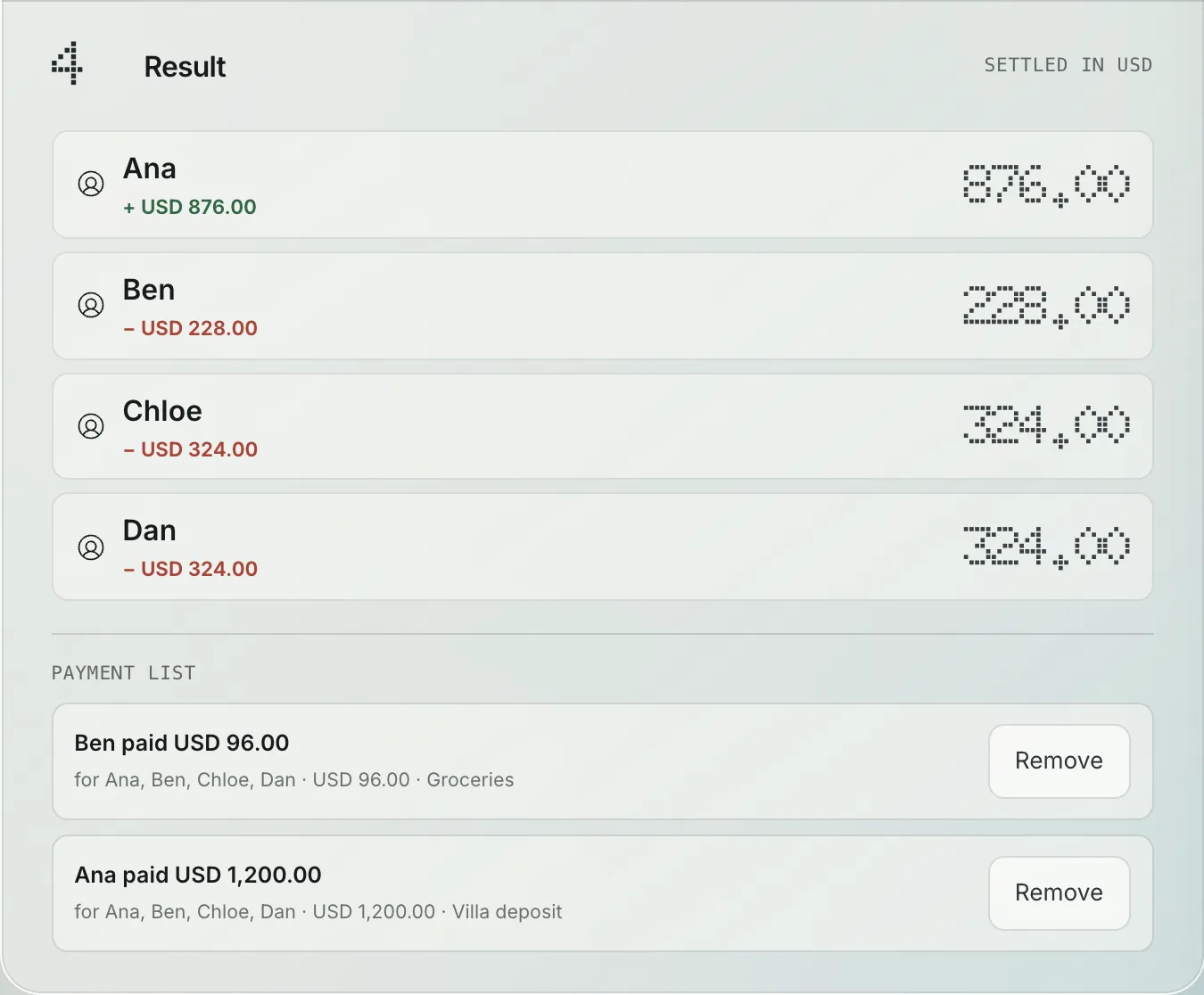
One person fronting a large booking, exactly the exposure this article is about. Ana put the villa deposit on her card; Ben picked up groceries. Both split evenly across the four.